Sourdough croissant (inspired from thefreshloaf)
- Yield:6 pieces
- Time:1 day, 44 mins show details

Delicious sourdough croissant recipe inspired from thefreshloaf (thefreshloaf.com/node/284...). I made a few minor modifications and divided the quantities by two. Check out her blog as she provides many tips on the topic !
Ingredients
- Levain "dur"
- 18 gramssourdough starter, 100% hydration
- 30 gramsfiltered water
- 53 gramsbread flour
- Layered dough
- 211 gramsbread flour
- 61 gramswater
- 64 gramsmilk
- 34 gramssugar
- 4 gramssalt
- 3 gramsdry yeast
- 10 gramsbutter, softened
- All the levain
- Rolling butter
- 144 gramsbutter
- Egg wash
- 1egg
- ½ teaspoonliquid cream optional
- ½ teaspoonhoney optional
- 1 pinchsalt
Equipment
- bowl
- rolling pin
- tray



Preparation
- 10 hrs
Mix together all the ingredients for the levain and let the mix rest for 8 to 12 hours, or until doubled/tripled in size and bursted bubbles are present on the top.
- 5 mins
Warm up the water and milk mixture (until it feels not too cold not too warm when you dip a finger in) and dissolve the dry yeast in.
- 5 mins
Mix all the ingredients for the dough in a bowl and knead until combined.
- 30 mins
Let the dough rest on the counter for 20 to 30 minutes.
- 5 mins
After 30 minutes, knead again until soft and smooth. This should be fairly fast and easy after the 30 minute' rest.
- 10 hrs
Cover the bowl (don't cover the dough tightly at this stage as it will rise) and let it rest in the fridge overnight.
- 5 mins
The next day, roll the rolling butter into a square of approximately 15 cm x 15 cm x 0.5 cm. For this, put the butter cut into pieces of approximately 1 cm of thickness into a piece of baking paper and fold the edges of the paper so as to form a square of 15 cm x 15 cm. Then smash and roll the butter with a rolling pin until it spreads to the desired shape.
- 5 mins
Get the dough from the fridge and poke it with one finger. Then, poke your butter layer. Do the two have a similar consistency ? If so, proceed to the next step. If the butter is harder, put the dough back in the fridge and let the butter rest on the counter until it softens. If the dough is harder, put the dough and the butter back into the fridge. If the butter is too soft even after a few hours in the fridge, consider using another brand...
- 5 mins
Enclose the butter layer in the dough (see this image from thefreshloaf : i78.photobucket.com/album...).
Starting from the center, roll GENTLY from center to corners first. Then elongate the dough from center to side to obtain a rectangle of ratio 1:3. In the beginning, if the dough is hard, you can press on it with the rolling pin instead.
- 5 mins
Perform the first fold as follows.
Put the dough with the short side facing you. Grab the top portion of the dough (the one furthest from you) and fold it over the two thirds. Then grab the bottom portion and fold it over. A picture is worth a thousand words :).
When rolling, if the butter feels too stiff, let the dough rest on the counter for a while (otherwise, the stiff butter will break up into big chunks and pierce through the layers). If the butter starts to melt, put the dough back in the fridge for 30 minutes (otherwise, the melted butter will stick the layers together, or leak from the dough. Either way, it is not good).Cover with plastic wrap or a plastic bag (hermetically) and let it rest in the fridge for at least one hour.
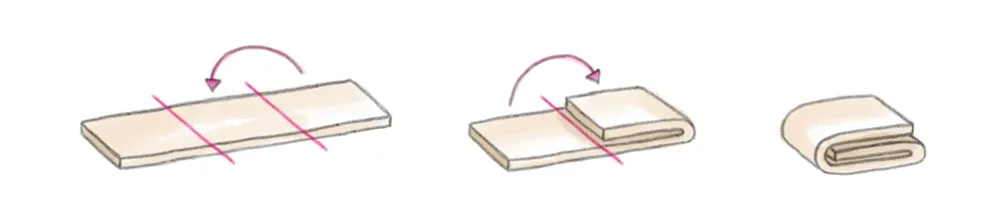
A three-layer fold.
- 5 mins
Get the dough out of the fridge and perform your second and last fold as follows.
Position the dough so that the previous fold is now horizontal. Gently roll the dough from the center and elongate it until a rectangle of ratio 1:4 forms. Fold the top portion to the middle of the rectangle, the bottom portion to the middle also. And fold the two halfs. Have a look at the picture :).
Cover and let the dough rest in the fridge for at least an hour.
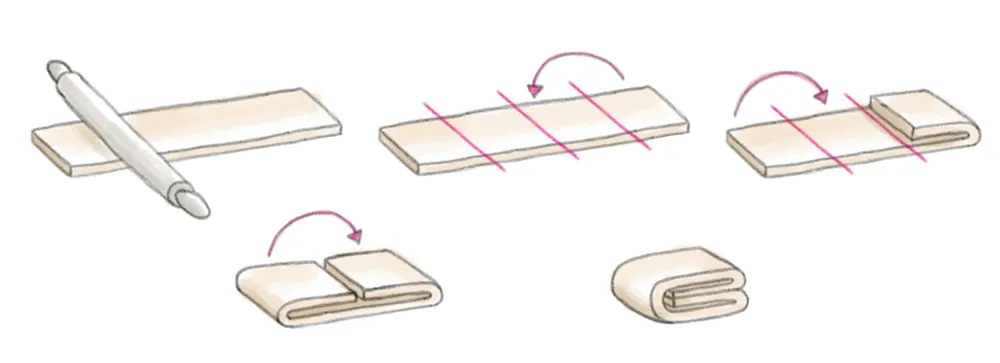
A four-layer fold.
- 5 mins
Roll the dough into a rectangle of approximately 20 cm large and 0.3 to 0.5 cm thickness. The length does not really matter.
- 8 mins
Cut a series of triangles of 20 cm height, 10 cm long at the base. Take each triangle, slightly stretch it and roll it lengthwise starting from the base. Put the croissant on a rack with the tip tucked under itself, and proceed to the next. You should end up with approximately 6 croissants plus a little extra from the edges.
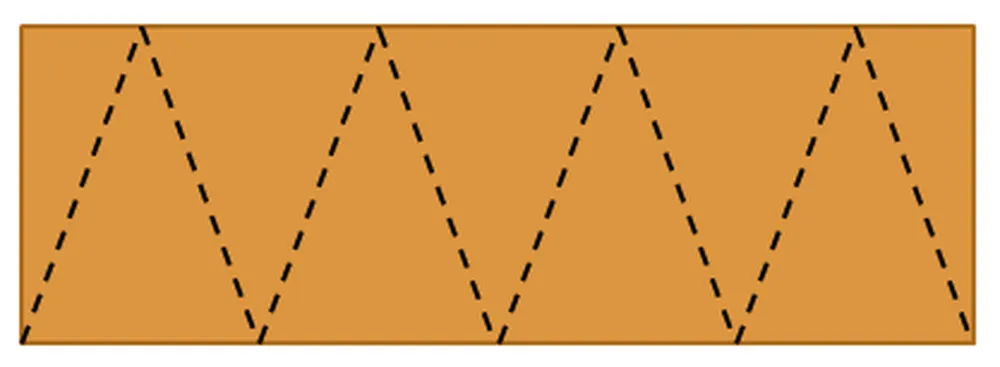
An example of triangle pattern for croissants. Half rectangles are fine too.
At this point, you can either proof your croissants, or put them back in the fridge overnight and proof them the next day, or freeze them.
- 1 min
Prepare the egg wash : mix all the ingredients for the egg wash together.
- 3 hrs
For the proof, brush a layer of egg wash on the croissants, avoiding the layers and let the croissants rest for 2 to 3 hours at approximately 20-25°C (do not go higher than 30°C which is the melting point of butter). I keep mine in a switched off oven.
- 5 mins
After proofing, the croissants should have doubled in size and be jiggly. The layers should be visible. Brush a second layer of egg wash.
- 15 mins
Preheat the oven at 220°C and bake for about 15 minutes or until golden brown.
Notes
This recipe requires a lot of resting time but very little actual working time. If find it not that difficult to achieve (maybe not on your first try though) if I respect the following rules :
* always make sure that the batter and the dough have the same consistency. If the butter is melting : put the preparation back in the fridge. If the butter is too hard : let the preparation rest on the kitchen counter for a while (there is no rule on the duration since it depends on the temperature in the kitchen...).
* if the dough is too elastic to be rolled, do not insist. Just put it back in the fridge for 30 minutes and try again.
* cover the dough well during resting times to prevent it from dehydrating. A dehydrated dough cannot rise correctly in the final proofing step. I found a great trick that I need yet to test : enclosing the tray containing the dough / shaped croissants in a clean plastic bag.
A few additional tips :
* some butters are harder and other softer at the same temperature. If you cannot manage to roll the dough without butter leakage despite following the previous rules, try using a different butter brand. In France, "Echiré" butter seems to be a good option for many home cooks.
* don't be afraid to try and fail :). Even if all the layers mingle together, the final result is still very appetizing (though closer to a brioche).
The pictures illustrating the folds were found here : bi-gout.com/blog/galette-...
Save this recipe to your collection
Sign up free
Discussion
Wow! This looks great - and so thorough! Can't wait to try!
Thanks ! I hope you will enjoy it ! By the way, I just remembered that when shaping the croissants, you need to tuck the tip of the triangle under the croissants. I heard that they might unroll if you don't do this.
deleted