Basic Sourdough Batard
- Yield:6 servings / 1 loaf
- Time:6 hrs, 40 mins show details
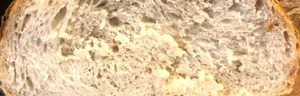
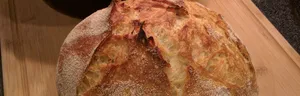
This is my go-to bread when making a purely flour-water-salt dough from my sourdough starter.
Ingredients
- 400 gramsbread flour, unbleached
- 100 grams
- 260 gramswater
- 10 gramssalt
Equipment
- Pizza stone, optional. Any kind of baking stone should suffice. A sheet pan is also fine.
Preparation
- 10 mins
In a large mixing bowl, mix the flour, starter, water, and salt together with a wooden spoon. Mix together enough so that it's cohesive, but gluten development is not a concern at this point.
- 5 mins
Give the dough several minutes to relax.
- 5 mins
Knead until the gluten network is strong and the dough is smooth.
When it's done, it should still be a little tacky, but pieces should not be coming off as you handle it. It should bounce back when pushed.
Place it in a covered or sealed container with room for it to rise.
- 5 hrs
Let the dough rise. Make sure it's covered and not in a cold place.
Every hour or so give the dough a turn: gently fold the dough over itself from each of 4 different "corners". This will strengthen the dough.
The strength of your starter can greatly influence the time. It may take more or less time, so look for the dough to have nearly doubled in size.
- 2 mins
Shape the bread. With flour sprinkled on your work station, you'll just need to make a few folds with the dough, folding it in on itself. The shape we're looking for in this case is a batard, so have a look here if you'd like specific instructions: youtube.com/watch?v=pqzRp...
After shaping it, make sure it's again covered somehow, perhaps by loosely fitting plastic wrap dusted with a little flour.
With a pizza or baking stone inside (if using), preheat the oven to 390 F.
- 30 mins
Wait for the dough to relax and the oven to heat up.
- 2 mins
With a very sharp knife, razor, or lame, score as desired (youtube.com/watch?v=FVOtt...). Put the bread into the oven on the pizza/baking stone. If not using one, just put it in on a baking sheet.
- 35 mins
Wait for the bread to finish baking. It should be browned, but not burnt. If it's not browned leave it in a little longer.
- 1 min
Remove the bread from the oven and place on a cooling rack.
- 10 mins
Allow the bread to cool for at least 10 minutes.
Notes
Please feel free to try varying the timings. The starter will act faster or slower depending on temperature, how long it's been sitting, the type of flour, the type of water, etc., meaning the rise may vary drastically. Every oven will also behave differently.
Expect for this to take a few times before your results are consistent.
Save this recipe to your collection
Sign up free
Discussion
This is great, can't wait to try it with my growing starter! I don't have a pizza stone but I do have a cast iron dutch oven, I love how the crust develops in the enclosed container.